
Archive
October 14, 2026

▾ Hover for summary ▾ Tap for summary
Cabinet approved about 316,770 million baht in multi-year government spending commitments for the FY2027 budget (the year starting Oct 2026), equal to 7.98% of the recurrent budget and within the 10% legal cap. Most of it is with the Transport Ministry. The Budget Bureau has told agencies to speed up procurement to push money into the economy. Agencies paying in foreign currency must weigh current exchange rates, since the baht has been volatile. For SMEs, this is a possible source of construction, logistics and supply contracts, so check procurement announcements from transport-related agencies in coming months.

▾ Hover for summary ▾ Tap for summary
The national catastrophe insurance scheme has been in force since 1 Oct 2026 and made its first death payout (2 million baht) after the Chiang Mai flash flood on 5 Oct. Coverage covers flood, windstorm and earthquake for about 30 million homes: up to 100,000 baht per property, with initial payments of 10,000 baht for flood and 5,000 baht for windstorm or earthquake. Claims go through www.thaiNATCAT.org, LINE @ThaiNATCAT, or 0-2012-5555; the OIC hotline is 1186. Check whether your home or shop is covered and keep damage photos and documents ready.
▾ Hover for summary ▾ Tap for summary
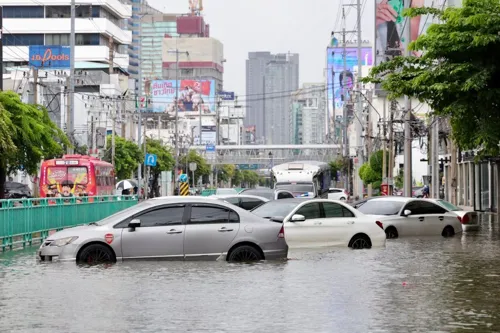
The cabinet has acknowledged principles for three draft laws that push back the start of employee-fund contributions (เงินสะสม and เงินสมทบ) from 1 Oct 2026 to 1 Jan 2027, after the 25–29 Sep 2026 floods. From 1 Jan 2027 to 31 Dec 2031, employer and employee each pay 0.25% of wages, rising to 0.5% from 1 Jan 2032. The separation/death benefit rules also start 1 Jan 2027. Employers should update payroll and cash-flow plans for the new start date. These are principles only and still need the formal legal process, so confirm the final dates before changing payroll systems.

▾ Hover for summary ▾ Tap for summary
Cabinet backed a 50bn-baht GHB (ธอส.) home loan scheme for buyers of homes priced up to 3m baht, with loans up to 3m baht per borrower and repayment up to 40 years. It covers land-and-house purchases, house building, and home fittings. Special low rates apply at first, then move to the MRR reference rate. Applications run from the day after cabinet approval until 30 Dec 2030 or until the quota is fully lent. The government says it could generate about 125bn baht of economic activity in construction, building materials, and consumer spending. For builders, material suppliers, and home-related shops, this points to more buyer demand in the 3m-baht segment. Buyers with tight incomes should check repayments after the promotional rate ends.

 Empower businesses to thrive in the digital age.

▾ Hover for summary ▾ Tap for summary
The National Water Resources Office is draining floodwater from Ongkharak (Nakhon Nayok) via three canals, with the key points expected to clear in about 7 days. Chao Phraya releases below Chao Phraya Dam were cut to about 1,900 cu m/s. Nationally, reservoirs are at 82% of capacity, and heavy rain is forecast for 15-16 October in parts of the upper country, the central region, and the east. If your premises or deliveries are in Ongkharak, Pathum Thani or east Bangkok, plan for disrupted road access and wet stock or storage in the next week or so.

▾ Hover for summary ▾ Tap for summary
IMF's 2026 outlook keeps global growth at 3.1%, unchanged from April and October, but it warns that war-driven supply disruptions and El Niño could keep food and energy prices high. It also says central banks face a dilemma: inflation is slow to fall, so interest rate cuts are harder. For a Thai SME, plan for steady input costs and avoid assuming cheap borrowing soon. The report also flags currency volatility as a risk, with intervention only temporary.

▾ Hover for summary ▾ Tap for summary
IMF Managing Director Kristalina Georgieva said Thai borrowing costs will rise because global bond yields are likely to stay high for a long time, driven by energy-led inflation and AI-related investment demand. She said emerging-market spreads are stable, but the higher base rate is raising debt-servicing costs. Her advice for Thailand: lift growth, keep macro fundamentals strong, and trade more within ASEAN (intra-ASEAN trade is about 22%, versus 60% in the EU). For an SME, this is a reason to review floating-rate loans and avoid taking on new debt on the assumption that rates will fall soon. No specific rate change or deadline was announced.
▾ Hover for summary ▾ Tap for summary
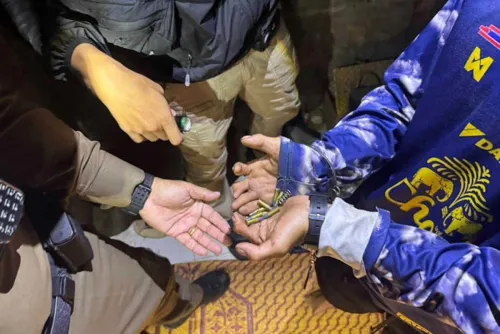
Police arrested 587 suspects in 25 provinces outside Bangkok on Tuesday to secure the 2026 IMF-World Bank Group meetings in the capital. The Civil Aviation Authority also banned drone use in Bangkok on Friday, from 12.01am to 11.59pm. For a small business, the practical effect is limited to possible traffic checks or drone restrictions around the meeting days if you operate or film drones in Bangkok.
 Your real translator for LINE and Discord.

▾ Hover for summary ▾ Tap for summary
IMF forecasts Thailand GDP growth of 2.1% in 2026 and 2.1% in 2027. World Bank forecasts 2.0% and 2.3%. Vietnam is expected at 7-8%+ over the same period, the fastest in ASEAN. Brunei's IMF forecast falls from 1.9% to 1.3%; World Bank does not publish one. For a Thai SME this is background: low domestic growth means demand stays soft, so keep prices, stock and hiring plans conservative. Vietnam's growth is a signal for export and regional-sourcing opportunities rather than a direct change in your costs.

▾ Hover for summary ▾ Tap for summary
The national disaster insurance scheme has started paying claims: the first 2 million baht accident payout went to heirs of a flood death in Chiang Mai. Coverage since 1 October 2569 (2026) covers floods, windstorms and earthquakes via a group policy. The household property policy covers about 30 million homes, up to 100,000 baht per household per event, with initial payouts of 10,000 baht for floods and 5,000 baht for wind or quake. Owners should check whether their home is covered and tell staff how to report damage to the Office of Insurance Commission (คปภ.) quickly.

▾ Hover for summary ▾ Tap for summary
Chinese arrivals to Thailand fell about 34% to roughly 4.47 million in 2025, and Malaysia overtook Thailand as the top source market. Trip.com's CEO says Thai competition is now global, and that safety must be visibly communicated, not just exist. Practical moves she points to: schedule promotions ahead of the four long holiday windows (1-2 weeks each), tailor offers by generation (tour groups with Chinese-language guides for older travellers, history and culture for families, events for Gen Z, off-season trips for retirees), and bundle hotels, transfers, restaurants and activities into packages sold on platforms Chinese travellers use.

▾ Hover for summary ▾ Tap for summary
Six forecasters (BOT, NESDC, IMF, Ministry of Finance, World Bank, ADB) put Thai growth for 2026 between 2.0% and 2.3%. The BOT's 2.3% is the highest, and none reach the 2.7% potential the BOT cites. For a small business this points to a sluggish domestic demand year: plan sales conservatively, avoid over-hiring or big capacity expansion on optimistic growth assumptions, and watch cash flow closely.

 Want to buy or sell a business?

▾ Hover for summary ▾ Tap for summary
The US safety regulator NHTSA plans to update its federal headlight standard (FMVSS No. 108), covering LED, adaptive and auto high-beam tech and glare. Public comments on the working group are due 9 Nov 2569 (2026). This is a US rule, so it changes nothing for a Thai business now; only relevant if you import or export vehicle lighting parts to the US.
▾ Hover for summary ▾ Tap for summary
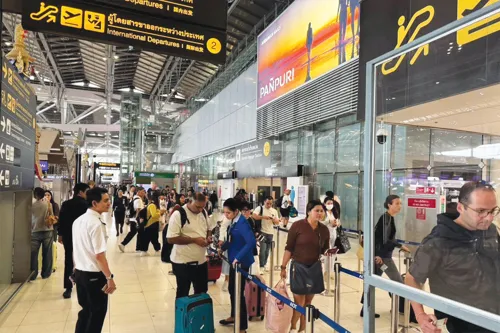
A draft Exit Fee law would charge every air passenger leaving Thailand 1,000 baht per trip initially, capped at 5,000 baht. Tourism bodies (TTIA, THA, ATTA, TTAA) have asked the Finance Ministry and Revenue Department to review it, warning of higher travel costs, weaker demand and lower flight capacity. The idea is still only a proposal, not law. If you run a tour, travel, hotel, or transport business, keep it in your planning as a risk to bookings and pricing, and watch for public hearings.

▾ Hover for summary ▾ Tap for summary
The Agriculture Ministry plans to request 8 billion baht from emergency loan decree funds to buy 500 electric harvester/tractor units at about 16 million baht each, to cut rice harvesting costs. Critics say the EV price looks inflated versus the roughly 1.6 million baht market price for EVs; the minister argues lifetime fuel savings of over 10 billion baht over 14 years justify it. The proposal goes to the Finance Ministry's review committee in about 2 weeks. For a Thai SME this is mainly a signal: if you sell to or depend on rice farmers, the government may subsidise EV farm machinery, and the minister claims EV-harvested rice could fetch better prices in export markets with environmental rules. No action needed yet.
▾ Hover for summary ▾ Tap for summary
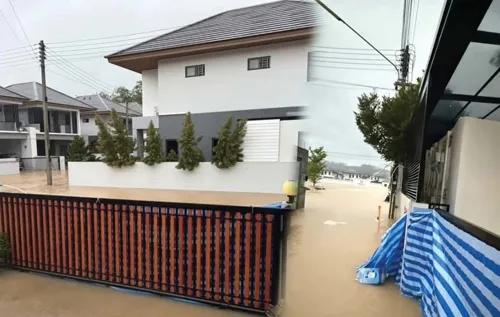
Developers expect flood-related buying slowdown of at least 6 months, mainly in flood-hit eastern Bangkok. Columnist says the bigger problem is that homes can be sold but not transferred, because banks are not lending. Flood-prone areas like Romklao may see less interest, and a trend toward raising houses, rebuilding, or moving to condos is likely. For a builder, supplier or property-related SME, plan for slower cash flow in the next half-year and check customers' loan approval before committing.
 Together GoWeGo! Ferry tickets in Thailand.

▾ Hover for summary ▾ Tap for summary
Toxic effluent on the Prachin River (Kabin Buri to Ban Sang) killed wild and caged fish. Cage tilapia farmers report losses of 700,000 baht or more per farm, and some sold fish at 20-25 baht/kg versus about 100 baht normally. The provincial meeting resolved to propose closing two factories to the Department of Industrial Works, and the Department of Fisheries will test carcasses for contaminants. Farmers say compensation is not realistic and warning systems are missing. If you run a business along this river or source fish or water from it, check your exposure, keep records of losses for any compensation claim, and watch for stricter discharge enforcement in the area.
▾ Hover for summary ▾ Tap for summary
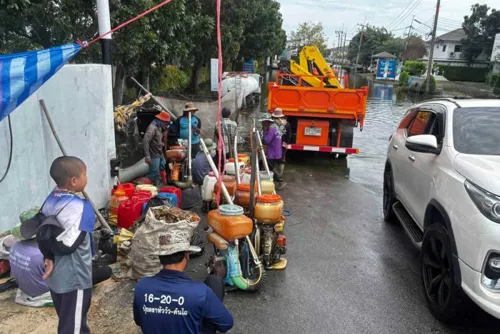
As of Wednesday morning (14 October 2026), floods still affected about 905,233 families (around 2.45 million people) in Bangkok and 20 provinces, mainly the Central Plains, with levels declining. Hardest hit: Ayutthaya, Pathum Thani, Prachin Buri, Nakhon Nayok and Chachoengsao. If your premises, stock, transport routes or suppliers are in these areas, check access and stock now, and expect slower deliveries and weaker local demand while water recedes.

▾ Hover for summary ▾ Tap for summary
Brent fell to about US$105.69 a barrel and West Texas rose to about US$94.14 on 13 Oct 2026, as markets expect Russia to supply about 0.3 million tonnes of diesel to the US and allies in October. OPEC+ output rose about 0.9 million barrels a day in September, but shipping through the Strait of Hormuz remains constrained and Saudi-Yemen fighting is a live risk. Global diesel prices have hit record highs in recent weeks. For a Thai SME, keep fuel and logistics budgets conservative and avoid assuming near-term relief at the pump; review diesel-linked delivery costs and pricing clauses.

▾ Hover for summary ▾ Tap for summary
Gold dropped about 300 baht versus the previous close, per the Gold Traders Association at 10:02. Bars buy at 66,000 and sell at 66,200 baht per baht-weight; 96.5% jewellery buys at about 64,673 and sells at 67,000 baht. World spot is about 4,166 USD per ounce. The spread between buy and sell prices is wide for jewellery, so shops that buy back old gold should check their quotes before trading.

 Stop running your company on Excel.